BA' s Blog

Friday, 26 April 2024

Assignment : 108

 Assignment 108 : Ernest Hemingway: Exploring His Unique Writing Style and Influential Works


Tables of Contents


Personal Information

Assignment Details

Abstract

keywords

Introduction

Ernest Hemingway: Examining His Unique Writing Style and Influential Works

The Hemingway Style: The Iceberg Theory

Use of Dialogue

Hemingway Code Hero

Influential Works

Impact on Literature

Conclusion

References


Personal Information :


Name : Reshma Yunusbhai Bilakhiya

Batch : M.A. Sem - 2 (2024)

Enrollment no : 5108230008

E - mail address : reshmabilakhiya21@gmail.com

Roll no: 23


Assignment Details : 

Topic: Ernest Hemingway: Exploring His Unique Writing Style and Influential Works

Paper & Subject Code : 108 The American Literature & 22401

Submitted to : Smt. Sujata Binoy Gardi, Department of English, 

MKBU, Bhavnagar

Date of Submission : 25th April, 2024.


Abstract :

Ernest Hemingway, one of the most celebrated American writers of the 20th century, is renowned for his distinctive writing style and influential works. This presentation delves into Hemingway's unique approach to storytelling, analyzing key elements of his writing style and exploring some of his most significant works. Through an examination of Hemingway's prose, themes, and characters, this study aims to provide insight into the enduring legacy of this literary icon.


Keywords : 

Ernest Hemingway, Writing style, Iceberg Theory, Dialogue, Hemingway Code Hero, Influence on Literature.


Introduction : 

Ernest Hemingway's impact on American literature is undeniable, characterized by his spare and straightforward writing style. This presentation explores the elements that define Hemingway's writing, from his use of dialogue to his portrayal of themes such as war, love, and masculinity. Through an analysis of his influential works, including "The Old Man and the Sea," "A Farewell to Arms," and "For Whom the Bell Tolls," this study aims to shed light on the enduring legacy of Hemingway's unique voice in literature.


Ernest Hemingway: Examining His Unique Writing Style and Influential Works

Ernest Hemingway, born on July 21, 1899, in Oak Park, Illinois, emerged as one of the most influential writers of the twentieth century. His novels and short stories, characterized by his distinctive writing style—terse, sparse, and devoid of excess—revolutionized the landscape of American literature. This article aims to delve into the unique writing style of this literary titan and provide an analysis of his influential works that cemented his immortality in the literary world.


The Hemingway Style: The Iceberg Theory

Hemingway’s writing style can be described as lean, hard, athletic, and devoid of excessive language. His narratives often use a simple vocabulary and short sentences that mirror the philosophy behind his ‘Iceberg Theory.’ Hemingway stated, “If a writer knows enough about what he is writing about, he may omit things that he knows, and the reader, if the writer is writing truly enough, will have a feeling of those things.”

His Iceberg Theory, also known as the theory of omission, is a writing technique that suggests the deeper meaning of a story should not be evident on the surface but should shine through implicitly. It is the hidden 7/8ths of the iceberg under the water that holds the story’s substance, leaving the reader to unearth and appreciate the underlying themes. The theory was a reaction against the 19th-century style of describing the world in minute detail; instead, Hemingway offered only the ‘tip of the iceberg,’ encouraging the reader to perceive what’s hidden beneath the surface.


Use of Dialogue

Another characteristic feature of Hemingway’s writing is his adept use of dialogue. His characters communicate in a realistic, often colloquial language, revealing their personalities and emotions subtly, without direct authorial intervention. This narrative technique, which creates an illusion of real people talking, further reinforces the Iceberg Theory, leaving much unsaid for the readers to infer.


Hemingway Code Hero

Hemingway’s works frequently feature a particular type of protagonist known as the ‘Hemingway Code Hero.’ These characters are often stoic men who exhibit grace under pressure, embrace physical and mental challenges, and adhere to their personal code of honor. They live in the existential world, focusing on tangible experiences and shying away from abstract thought or discussion about the meaning of life. The Code Hero, through his actions, embodies Hemingway’s beliefs about the nature of courage, honor, and endurance.


Influential Works

 The Old Man and the Sea (1952): This novella, one of Hemingway’s most famous works, earned him the Pulitzer Prize for Fiction in 1953 and significantly contributed to his Nobel Prize in Literature in 1954. The story of Santiago, an old Cuban fisherman battling a giant marlin, beautifully showcases Hemingway’s iceberg theory. The simple, austere narrative surface belies the profound themes of human courage, endurance, and the relentless struggle against natural forces.

 A Farewell to Arms (1929): Set during World War I, this novel showcases the trauma and disillusionment of war through the eyes of Frederic Henry, an American ambulance driver in the Italian army. The tragic love story between Henry and Catherine Barkley, a British nurse, underlines the futility of war and the fragility of human life. The novel’s hauntingly poignant ending underscores Hemingway’s view of life as a tragic experience, ruled by arbitrary and cruel forces.

 The Sun Also Rises (1926): Known as Hemingway’s quintessential novel, it presents the ‘Lost Generation’ disillusioned by World War I. The narrative, filled with vibrant dialogue and a compelling plot, explores themes of love, masculinity, and the purposeless life of the expatriate community in post-war Europe. The characters are caught in a cycle of aimless drinking and partying, embodying the moral and spiritual bankruptcy of the age.

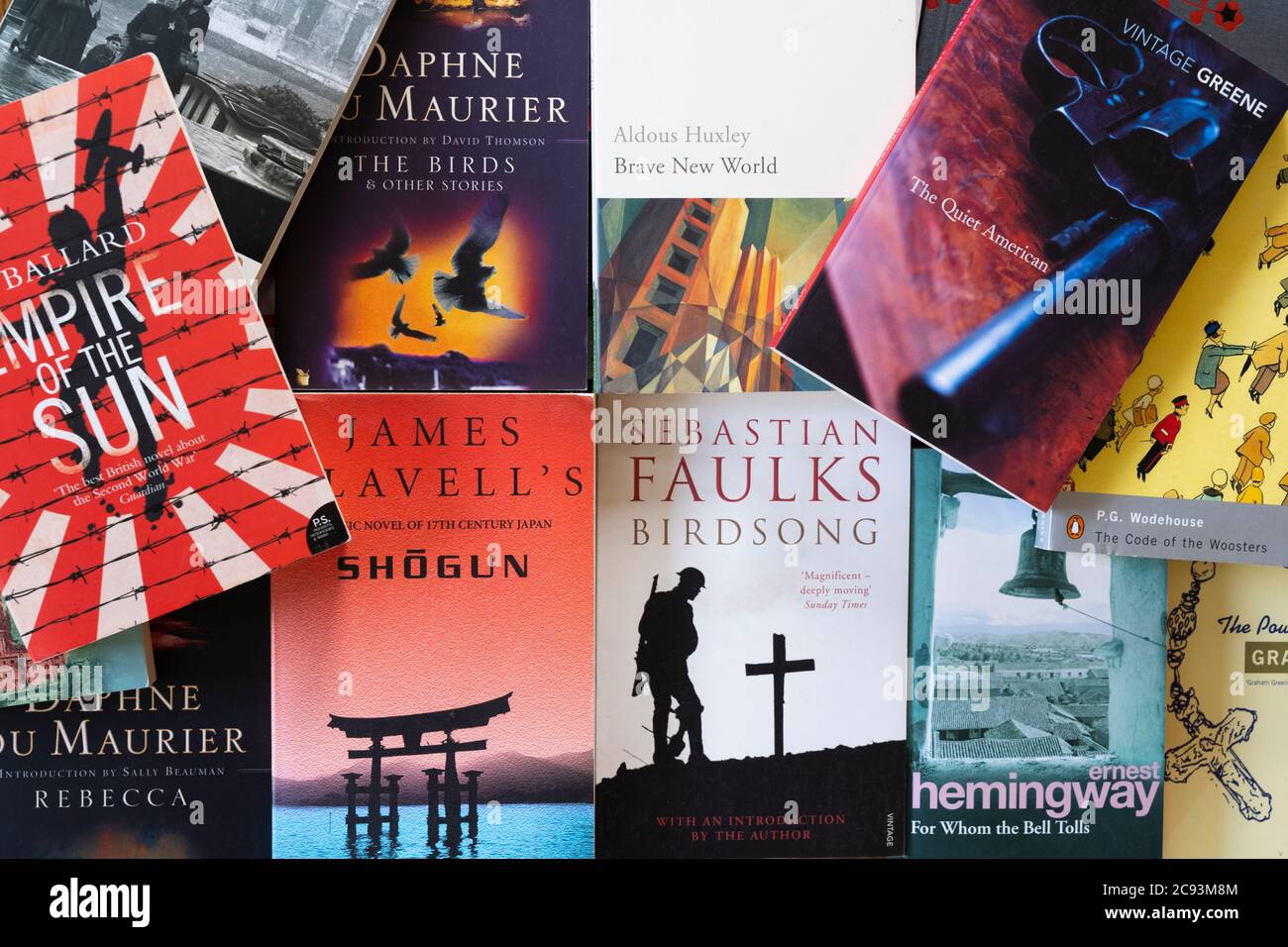
 For Whom the Bell Tolls (1940): Based on Hemingway’s experiences in the Spanish Civil War, the novel explores themes of love, death, and the brutality of war. The protagonist, Robert Jordan, embodies the Hemingway Code Hero, showcasing bravery, practicality, and a stoic acceptance of his fate.


Impact on Literature

Hemingway’s unique style and approach to storytelling greatly influenced modern literature. His Iceberg Theory inspired authors to lean towards subtlety, leaving much to the reader’s imagination. His use of dialogue set a new standard in the creation of realistic, believable characters. Moreover, his ability to evoke emotion through minimalistic prose influenced the next generations of writers.


Conclusion : 

Ernest Hemingway was indeed a master of the written word. His evocative narratives, characterized by a distinctive, pared-down style and profound underlying themes, have ensured his place in the pantheon of literature’s immortals. Hemingway’s indelible influence continues to resonate in the literary world, affirming the timeless relevance of his works.Through an examination of Hemingway’s writing style and influential works, we gain an understanding of his innovative approach to storytelling. Hemingway’s legacy endures, a testament to his unique vision, and remains an enduring inspiration to writers and readers worldwide. His writings continue to fascinate, provoke, and inspire, preserving his immortality in the world of literature.


Reference

Ballan, Danny. “Ernest Hemingway: Exploring His Unique Writing Style and Influential Works.” English Plus Podcast, 4 June 2023, englishpluspodcast.com/ernest-hemingway-exploring-his-unique-writing-style-and-influential-works/. 


Word Count : 1133

Image : 1

Thank You!!


Assignment : 109

 Assignment 109 : Rasa Theory (Indian Aesthetics); Summary & Analysis


Tables of Contents


Personal Information

Assignment Details

Abstract

keywords

Introduction

Features of Rasa Theory 

Bhavas in Indian Aesthetics

Sthaibhavas

Vhibhavas

Anubhavas

Vyabhikaribhavas

Rasas in Indian Aesthetics

Shringara Rasa

Karuna Rasa

Hasya Rasa

Rudra Rasa

Other Rasas

Conclusion

References


Personal Information 

Name : Reshma Yunusbhai Bilakhiya

Batch : M.A. Sem - 2 (2024)

Enrollment no : 5108230008

E - mail address : reshmabilakhiya21@gmail.com

Roll no: 23


Assignment Details 

Topic: Rasa Theory (Indian Aesthetics); Summary & Analysis

Paper & Subject Code : 109 Literary Theory & Criticism & Indian Aesthetics

Submitted to : Smt. Sujata Binoy Gardi, Department of English, 

MKBU, Bhavnagar

Date of Submission : 25th April, 2024.


Abstract 

Rasa theory is a fundamental concept in Indian aesthetics, particularly in the fields of literature, dance, and drama. This theory explores the emotional and aesthetic experiences evoked by artistic works, emphasizing the role of the audience in the creative process. This paper provides a comprehensive summary and analysis of the Rasa theory, tracing its historical development, its key components, and its significance in Indian cultural and artistic traditions.


Keywords

Rasa theory, Indian aesthetics, emotional aesthetics, literature, drama, Indian philosophy, audience participation.


Introduction

Rasa Theory asserts that entertainment (in the drama/performance) is expected to evoke Rasa or joy (artistic) but that is not the primary goal. The primary goal is instead to create parallel life in front of the audience to experience a sense of one’s own (i.e. Consciousness, spiritual and moral question).

Bharatamuni believes that the dramatic form of aesthetic experience is the most perfect fruition of aesthetic activity because drama is the synthesis of all arts.

According to Abhinav Gupta (one of the famous critics of Natyashastra), Rasa is the simplest and most we bewildering expression in the Sanskrit language. Anyone can experience it but cannot define it precisely.


Features of Rasa Theory

  1. Rasa means aesthetics, juice, essence, taste in performance. 
  2. Rasa is an undefinable realization and intense feelings with detachment.
  3. It is the flavor (general) or aesthetic emotion (metaphorical). 
  4. It is the soul of poetry. 
  5. Rasa is an emotion and cannot be described in opposition to Aristotle.
  6. Originally, Rasa means juice, essence or elixir. 
  7. It is the pleasure experienced by each class of people. 
  8. No other word can define Rasa completely. 
  9. It is the impression created on the mind of the sympathetic audience by the expressions of Bhavas (emotions) and it’s experienced by it. 
  10. Rasa is not experienced in common situations but only in the art form.


Rasa’s Foundation is laid upon a particular view of psychology that holds our personality and according to which a few primary emotions live in the conscious and subconscious state of our being.

These emotions are vast, amusing, pathetic, heroic, passionate, fearful, disgusting and wonderful. Later on peaceful, intellectual and devotional were also added.

  • These emotions are running in a permanent manner and may in the sense called dominant emotions. (Sthaibhavas).
  • These prominent states that determine particular internal temperaments are regarded as the dominant characteristics of those emotional states.


According to Bharatmuni, the realization of Rasa results from the Union of Vibhavas, Anubhavas, and Vyabhikaribhavas. When Sthaibhavas unite with others, the three Bhavas, one attains the quality of Rasa.


Bhavas in Indian Aesthetics

Sthaibhavas

  • These are the permanent or dominant moods.
  • They are 8 in number- Rati (love), Hasya (humorous), soka (sorrow), krodha (anger), utsaha (enthusiasm), bhaya (fear), jugupsa (disgust) and vismaya (wonder)
  • Later on, passiveness was added by Abhinavgupta and Anandvardhana.
  • Sthaibhavas are the basis of Rasa and are supreme among all Bhavas which are 49 in number.
  • Sthaibhavas constitute the principal theme of a composition.
  • They run all emotions like garland and cannot be overpowered by them. Rather the latter feed and strengthen them and help them emerge as Rasa.


Vhibhavas

They are the situations which are responsible to bring out Sthaibhavas. Vhibhavas have two aspects- Alambana and Uddipana. The person in whose mind Sthaibhavas run is known as Allambana Vibhavas.

The moonlit, spring, soft breeze, fragrance of flowers are Uddipanana Vhibahavas. In other words, they are stimuli.


Anubhavas

They are their effect seen upon the character after the emotions arise in the actor(s). They make spectators feel or experience Abhinaya by words and gestures.


Vyabhikaribhavas

They are the transitory and temporary mental states.

  • They strike mind and become the cause of experiencing a permanent mood.
  • They are 33 in numbers. Some of them are a weakness, depression, anxiety, despair, etc.
  • They spring out of principal emotion and ultimately merge into it.
  • They are like waves and bubbles that appear and disappear as the mighty stream of dominant emotion flows on, smiling and replying and dancing.

The realization of Rasa is the result of the union of Sthaibhavas, Vibhavas, Anubhavas, and Vyabhikaribhavas. Rasa theory draws a clear distinction between real-life experience and art experience- unordinary. In order to realize Rasa that must possess an adequate degree of intellectual and emotional equipment.


Rasas in Indian Aesthetics

Shringara Rasa

  • It is given the highest honor ever since the beginning of Poetics.
  • Sthaibhava or emotion of this erotic sentiment is Rati or love. Hero and heroine are Alambana Vibhavas. Swam, youth, solitude, songs of cuckoo are Uddipana Vibhavas.
  • Sideglances, twisting of limbs, brows are Anubhavas.
  • Leaving aside, the fight is Vyabhikaribhvas.
  • Collectively they provide joy Shringara Rasa.

Karuna Rasa

  • It emerges due to Soka (grief).
  • It is pleasurable as it has the power to meet the human heart.
  • A deceased person is Alambana.
  • Reference to him is Uddipana.
  • Cursing destiny, stupefaction are the Anubhavas.
  • Disgust, anxiety and uneasiness are Vyabhikaribhavas.


Hasya Rasa

It is the comic elements. It happens by showing unseemly dress, ornaments, quarrels, defective limbs etc.

Rudra Rasa

  • Anger, rape, abuse, insult, threatening, jealousy etc ate Alambana Vhibhavas.
  • Beating, breaking, crushing, cutting are Uddipana Vhibahavs.
  • Red eyes, knitting of eyebrows, biting of lips, determination, energy, restlessness and trembling are Vyabhikari Bhavas.

Other Rasas

  • Vira Rasa (zeal or utsaha)
  • Bhayanka Rasa (fear or Bhaya)
  • Adhbuta Rasa (Vismaya)
  • Santa Rasa (Nirveda)

Conclusion:

In conclusion, Rasa theory stands as a cornerstone of Indian aesthetics, offering a unique perspective on the emotional and aesthetic experiences evoked by artistic works. Through its emphasis on the audience's role in the creative process and its exploration of the interconnectedness of human emotions and artistic expression, Rasa theory has had a profound influence on Indian literature, drama, dance, and visual arts. Despite its ancient origins, Rasa theory continues to be relevant in contemporary discussions on aesthetics and remains a vital aspect of Indian cultural and artistic traditions. As we continue to explore and analyze the intricacies of Rasa theory, we gain deeper insights into the rich tapestry of Indian aesthetics and the universal human experience of art and emotion.

Word Count : 1125

Image : 1

References : 

https://www.tutorialspoint.com/rasa-an

d-its-constituent-elements

https://englishsummary.com/rasa-theory/#google_vignette


Assignment 106

  Assignment 106 : Exploring the Themes of “The Great Gatsby”


Table of Contents

Personal Information

Assignment Details

Introduction

Abstract

Keywords

The Decline of the American Dream in the 1920s

The Hollowness of the Upper Class

Class

The American Dream

Love and Marriage

Conclusion 

Reference


Personal Information


Name : Reshma Yunusbhai Bilakhiya

Batch : M.A. Sem - 2 (2024)

Enrollment no : 5108230008

E - mail address : reshmabilakhiya21@gmail.com

Roll no: 23


Assignment Details :

Topic: Exploring the Themes of “The Great Gatsby”

Paper & Subject Code : 106 : The 20th Century Literature : 1900 to World War 2

Submitted to : Smt. Sujata Binoy Gardi, Department of English,

MKBU, Bhavnagar

Date of Submission : 25th April, 2024.


Introduction:

"The Great Gatsby" by F. Scott Fitzgerald is not only a classic of American literature but also a novel that delves deep into various themes that continue to resonate with readers. In this paper, we will explore and analyze some of the central themes of the novel, including the American Dream, social class, love and obsession, and the corrupting influence of wealth. Through this exploration, we aim to uncover the profound insights that Fitzgerald offers into the society and culture of the Jazz Age, as well as into the timeless aspects of the human condition.


Abstract:

"The Great Gatsby," written by F. Scott Fitzgerald, is a novel rich with complex themes that continue to captivate readers. This paper examines the prominent themes found within the novel, including the American Dream, social class, love and obsession, and the corrupting influence of wealth. Through a detailed analysis of these themes, we aim to gain a deeper understanding of Fitzgerald's exploration of the Jazz Age and the human condition.


Keywords:

The Great Gatsby, F. Scott Fitzgerald, American Dream, class, love, obsession, wealth, Jazz Age, human condition


 Decline of the American Dream in the 1920s

On the surface, The Great Gatsby is a story of the thwarted love between a man and a woman. The main theme of the novel, however, encompasses a much larger, less romantic scope. Though all of its action takes place over a mere few months during the summer of 1922 and is set in a circumscribed geographical area in the vicinity of Long Island, New York, The Great Gatsby is a highly symbolic meditation on 1920s America as a whole, in particular the disintegration of the American dream in an era of unprecedented prosperity and material excess.


Fitzgerald portrays the 1920s as an era of decayed social and moral values, evidenced in its overarching cynicism, greed, and empty pursuit of pleasure. The reckless jubilance that led to decadent parties and wild jazz music—epitomized in The Great Gatsby by the opulent parties that Gatsby throws every Saturday night—resulted ultimately in the corruption of the American dream, as the unrestrained desire for money and pleasure surpassed more noble goals.


When World War I ended in 1918, the generation of young Americans who had fought the war became intensely disillusioned, as the brutal carnage that they had just faced made the Victorian social morality of early-twentieth-century America seem like stuffy, empty hypocrisy. The dizzying rise of the stock market in the aftermath of the war led to a sudden, sustained increase in the national wealth and a newfound materialism, as people began to spend and consume at unprecedented levels. A person from any social background could, potentially, make a fortune, but the American aristocracy—families with old wealth—scorned the newly rich industrialists and speculators. Additionally, the passage of the Eighteenth Amendment in 1919, which banned the sale of alcohol, created a thriving underworld designed to satisfy the massive demand for bootleg liquor among rich and poor alike.

Fitzgerald positions the characters of The Great Gatsby as emblems of these social trends. Nick and Gatsby, both of whom fought in World War I, exhibit the newfound cosmopolitanism and cynicism that resulted from the war. The various social climbers and ambitious speculators who attend Gatsby’s parties evidence the greedy scramble for wealth. The clash between “old money” and “new money” manifests itself in the novel’s symbolic geography: East Egg represents the established aristocracy, West Egg the self-made rich. Meyer Wolfsheim and Gatsby’s fortune symbolize the rise of organized crime and bootlegging.

As Fitzgerald saw it (and as Nick explains in Chapter 9), the American dream was originally about discovery, individualism, and the pursuit of happiness. In the 1920s depicted in the novel, however, easy money and relaxed social values have corrupted this dream, especially on the East Coast. The main plotline of the novel reflects this assessment, as Gatsby’s dream of loving Daisy is ruined by the difference in their respective social statuses, his resorting to crime to make enough money to impress her, and the rampant materialism that characterizes her lifestyle.

Additionally, places and objects in The Great Gatsby have meaning only because characters instill them with meaning: the eyes of Doctor T. J. Eckleburg best exemplify this idea. In Nick’s mind, the ability to create meaningful symbols constitutes a central component of the American dream, as early Americans invested their new nation with their own ideals and values. Nick compares the green bulk of America rising from the ocean to the green light at the end of Daisy’s dock.

Just as Americans have given America meaning through their dreams for their own lives, Gatsby instills Daisy with a kind of idealized perfection that she neither deserves nor possesses. Gatsby’s dream is ruined by the unworthiness of its object, just as the American dream in the 1920s is ruined by the unworthiness of its object—money and pleasure. Like 1920s Americans in general, fruitlessly seeking a bygone era in which their dreams had value, Gatsby longs to re-create a vanished past—his time in Louisville with Daisy—but is incapable of doing so. When his dream crumbles, all that is left for Gatsby to do is die; all Nick can do is move back to Minnesota, where American values have not decayed.


The Hollowness of the Upper Class

One of the major topics explored in The Great Gatsby is the sociology of wealth, specifically, how the newly minted millionaires of the 1920s differ from and relate to the old aristocracy of the country’s richest families. In the novel, West Egg and its denizens represent the newly rich, while East Egg and its denizens, especially Daisy and Tom, represent the old aristocracy. Fitzgerald portrays the newly rich as being vulgar, gaudy, ostentatious, and lacking in social graces and taste. Gatsby, for example, lives in a monstrously ornate mansion, wears a pink suit, drives a Rolls-Royce, and does not pick up on subtle social signals, such as the insincerity of the Sloanes’ invitation to lunch. In contrast, the old aristocracy possesses grace, taste, subtlety, and elegance, epitomized by the Buchanans’ tasteful home and the flowing white dresses of Daisy and Jordan Baker.

What the old aristocracy possesses in taste, however, it seems to lack in heart, as the East Eggers prove themselves careless, inconsiderate bullies who are so used to money’s ability to ease their minds that they never worry about hurting others. The Buchanans exemplify this stereotype when, at the end of the novel, they simply move to a new house far away rather than condescend to attend Gatsby’s funeral. Gatsby, on the other hand, whose recent wealth derives from criminal activity, has a sincere and loyal heart, remaining outside Daisy’s window until four in the morning in Chapter 7 simply to make sure that Tom does not hurt her. Ironically, Gatsby’s good qualities (loyalty and love) lead to his death, as he takes the blame for killing Myrtle rather than letting Daisy be punished, and the Buchanans’ bad qualities (fickleness and selfishness) allow them to remove themselves from the tragedy not only physically but psychologically.


Class

In the monied world of The Great Gatsby, class influences all aspects of life, and especially love. Myrtle mentions this with regard to her husband, George, whom she mistook for someone of better “breeding” and hence greater prospects: “I thought he knew something about breeding, but he wasn’t fit to lick my shoe.” Similarly, Gatsby’s pursuit of Daisy is bound up with class. Only after amassing a large fortune does he feel able to make his move. At the end of the book, class dynamics dictate which marriage survives (Tom and Daisy), which one is destroyed (George and Myrtle), and which one will never come to be (Gatsby and Daisy). Only the most affluent couple pulls through the events that conclude the book. In fact, it seems that the accident may have brought them closer. When Nick spies on them through the window, he reports that “there was an unmistakable air of natural intimacy about the picture, and anybody would have said that they were conspiring together.” Because of their elite class status, Tom and Daisy share a belief that they are immune to the consequences of their actions. In the final chapter, Nick calls Tom and Daisy “careless people” who “smashed up things and . . . let other people clean up the mess they had made.”


The American Dream

The American Dream refers to a shared set of ideals that guide the spirit of the United States. These shared ideals include a notion of freedom that ensures all Americans the possibility of upward social mobility, as long as they work for it. Every character in The Great Gatsby draws inspiration from the American Dream’s promise of wealth and prosperity. At the same time, the novel itself critiques the notion of the American Dream. Readers may end the novel wondering if the American Dream is actually attainable at all. Gatsby suffers the most from the promise of social mobility inherent to the American Dream. He spends his life believing that if he makes enough money and acquires enough possessions, he can transcend his lower-class birth and become equal to Daisy and Tom. However, even though Gatsby succeeds in acquiring wealth, he is never accepted by the upper class. Gatsby’s failure to attain the American Dream suggests the Dream is both an unattainable and unwise goal.


Love and Marriage

The ideals of love and marriage are profoundly strained in The Great Gatsby, a book that centers on two loveless marriages: the union between Tom and Daisy Buchanan and between George and Myrtle Wilson. In both cases, the marriages seem to be unions of convenience or advantage than actual love. Myrtle explains that she married George because she thought he was “a gentleman,” suggesting she hoped he’d raise her class status. Daisy nearly backed out of her marriage to Tom the day before her wedding, and Tom had an affair within a year of the wedding, but the couple is well-suited because of their shared class and desire for fun and material possessions. Even Gatsby’s all-consuming passion for Daisy seems more of a desire to possess something unattainable than actual love. Nick, meanwhile, dates Jordan Baker throughout the book, and though their relationship has its moments of warmth and kindness, both parties generally seem lukewarm and emotionally distant. “I wasn’t actually in love,” Nick recalls, “but I felt a sort of tender curiosity.” Such “tender curiosity” may be the closest thing to love in the entire novel.


Conclusion:

In conclusion, "The Great Gatsby" by F. Scott Fitzgerald explores a multitude of themes that continue to resonate with readers decades after its publication. Through the lens of the American Dream, social class dynamics, love and obsession, and the corrupting influence of wealth, Fitzgerald provides a poignant commentary on the society and culture of the Jazz Age. The novel's enduring relevance lies in its ability to shed light on timeless aspects of the human condition, such as the pursuit of happiness, the allure of material success, and the complexities of love and identity. As readers continue to explore the themes presented in "The Great Gatsby," they gain not only a deeper understanding of the characters and events within the novel but also a broader insight into the universal truths of human nature and society.


Reference : 

https://www.sparknotes.com/lit/gatsby/themes/


Word Count : 2008

Thank You !!


Assignment : 110

 Assignment 110 : Exploring the  Key Literary Movements of the 20th Century


Tables of Contents


Personal Information

Assignment Details

Abstract

keywords

Introduction

Major Movements of Twentieth Century

Modernist Poetry

Modern Fiction

Modernist Drama

Major Theories of the Twentieth Century


Personal Information


Name : Reshma Yunusbhai Bilakhiya

Batch : M.A. Sem - 2 (2024)

Enrollment no : 5108230008

E - mail address : reshmabilakhiya21@gmail.com

Roll no: 23


Assignment Details : 

Topic:   Exploring the  Key Literary Movements of the 20th Century

Paper & Subject Code : 110 A:  History of English Literature - From 1900 to 2000

Submitted to : Smt. Sujata Binoy Gardi, Department of English, 

MKBU, Bhavnagar

Date of Submission : 25th April, 2024.


Abstract :

The 20th century witnessed a myriad of literary movements that transformed the landscape of literature and shaped the way we understand and interpret texts. From modernism to postmodernism, these movements reflected the social, cultural, and political upheavals of the time. This paper provides an overview of five major literary movements of the 20th century, examining their defining characteristics, key figures, and significant works.


Keywords:

20th century, literary movements, modernism, postmodernism, surrealism, existentialism, feminist literature.


Introduction:

The 20th century was a period of immense change and innovation in the world of literature. Throughout this century, various literary movements emerged, each leaving a significant impact on the literary landscape. From the experimentation and disillusionment of modernism to the skepticism and self-reflexivity of postmodernism, these movements reflected the social, cultural, and political upheavals of the time. In this paper, we will explore five major literary movements of the 20th century, examining their defining characteristics, key figures, and significant works.


MAJOR MOVEMENTS OF TWENTIETH CENTURY

The modern movement emerged in the late 19th century , and was rooted in the idea that ‘traditional ‘forms of art ,literature ,social organization and daily life had become outdated , and that it was therefore essential to sweep them aside and reinvent culture. Beginning in the 1890s and with increasing force afterwards, a strand of thinking began to assert that it was necessary to push aside previous norms entirely, and instead of merely reviving past knowledge in light of current techniques, it would be necessary to make more thorough changes. The movement in art paralleled such developments as the Theory of Relativity in physics; the increasing integration of internal combustion and industrialisation; and the rise of social sciences in public policy. In literature, the symbolist movement had a tremendous influence on the development of the Modernism, because of its focus on sensation. Philosophically, the break with the tradition by Nietzsche and Freud provides a key underpinning of the movement going forward: to begin again from first principles, abandoning previous definitions and system.


 It was the fear of an impending war that dominated the first decades of the 20th century. The publication of Origin of Species in 1859 marked the erosion of religious belief simultaneous with the rise of new technologies. Foundations of Christianity were shaken and Nietzsche made his controversial statement, “God is dead, we have killed him”. A change over from an agrarian society to the Industrial resulted in the destabilization of moral values resulting in a state of acute identity crisis depicted in ‘the heap of broken images ‘in The Wasteland. Modernism marks a break in the Renaissance tradition of Humanism and centrality of the human subject/author, belief in permanent reality, perennial significance and values of the literary text crystallised with the invention of printing. The disorientation of European culture was reflected in the movements of Surrealism (Andre Breton) , Impressionism (Monet ), Symbolism (Baudelaire ,Rimbaud, Mallarme) ,Cubism (Picasso), Expressionism (Van Gogh ,Munch ,Gaugin), Dadaism (Tristan Tzara ) ,etc .These artists questioned the tyranny of conventional forms, colours, rhythm and harmony and represented reality as plural and subjective, affirming that art which exists for its own sake will provide the unity that is lost in contemporary society .


One of the major motifs of Modernist literature was myth which was expected to give shape and significance to a contemporary fragmented reality. Like Yeats in his Byzantium poems, Eliot in The Wasteland also tries to revive the lost spirituality in the ancient and oriental culture. The fragmentary technique of The Wasteland is also employed by Faulkner in The Sound and the Fury. The question of time also emerges in these works .The modernist individual is caught in an existential angst, devoid of dignity, purpose, value and meaning reminiscent of a Beckettian void and Kafkaesque claustrophobia manifest in Lucky , Pozzo ( Waiting for Godot) and Gregor Samsa (Metamorphosis). Modernist fiction vindicated colonial ideology to a larger extent. It involved a lament for the loss of European centre. The novels of Joseph Conrad and E.M .Forster offered ambiguous moral positions related to colonial issues .Virginia Woolf took a resisting feminist stance against the mainstream male canon.


MODERNIST POETRY

The first world war and its horror greatly influenced modern poetry .The War poetry developed into two phases : first, poets like Rupert Brooke who did not personally experience the horror of war and song of patriotism and nobility of sacrifice ; secondly ,those poets who like Wilfred Owen and Sassoon who had actually been to the war front and had known immense human suffering and depravity .Then came Georgian poetry which reacted against the decadent transitional poetry .The Georgians aimed at putting English poetry “on a new strength and beauty .” They aimed to treat natural things in a clear, natural and beautiful way, neither too modern nor too like the Victorians. They endeavoured to restore simplicity and naturalness to English poetry and avoided the use of archaic diction, grandiloquent expressions and all pomposities of thought and expression. Important Georgian poets are Walter de la Mare, W.H. Davies, John Masefield, John Drinkwater, Harold Munro and Alfred Noyes.


The poetical movement, known as Imagism, was a reaction against Romanticism, especially Georgian poetry .The Georgians lived in a world of fantasy and discarded the sordid realities of contemporary life. The Imagists reacted against the hackneyed and  fantastic approach of the Georgians. It was in vogue between the years 1910 and 1918. Its first anthology , Des Imagists was published in 1914 with Ezra Pound as the editor .The movement was spearheaded by Ezra Pound , James Joyce ,Hilda Doolittle , Amy Lowell ,T.E. Hulme ,William Carlos Williams, Ford Madox Ford, Richard Aldington while it evidently influenced T.S Eliot, W.B .Yeats, Wallance Stevens , Vorticists like Wyndham Lewis and poets of the 1930s.The Imagists liberated poetry from the shackles of classical discipline and waywardness of Romanticism. Pound defined an image as an “ intellectual and emotional complex in an instant of time ”. They experimented in ‘verse libre’ and believed in unlimited freedom of expression. They endeavoured to reveal the new consciousness in beautifully moulded images. Though the movement was criticised for its obscurity, licence and restrictiveness, it definitely inaugurated a distinctive feature of modernist poetry.


 The poets W.H .Auden, Stephen Spender ,Cecil Day Lewis and Louis MacNeice came to be known as the Oxford Poets .These poets were Oxford graduates and had been great friends when they were undergraduates. The Oxford poets “affirmed the value of being contemporary, of expressing the common experience, and the sensibility of the age ..”.The new poets took interest in current political and economic affairs and thought that Marxism was the only panacea to end all the evils infecting mankind. They had more intellectual appeal, contained marks of innovation and experimental ideas. These poets show the influence of Freud. Their poetical technique was greatly influenced by Imagism, French symbolism and Hopkins-Eliot innovations. Two new poets Dylan Thomas and George Barker weaned poetry away from the political consciousness which characterised the poetry of the Oxford Poets, and gave prominence to religion and romanticism and hence termed as neo romanticism. The poets of this period were also influenced by the Second World War .The notable poets who composed war poetry are Sidney Keyes, Alun Lewis, Alan Rock and Roy Fuller.

 Among the themes which recur in the work of war poets are the boredom and frustration of service life, the waste caused by war, appreciation of the friendship found in the services, a deep enjoyment of nature and of the landscape of home, and, above all the courage facing up to the hardships of struggle and the possibilities of ultimate death. The predominant note is that of sadness.


 The poets of the Apocalyptic movement centre on the individual and not the community. J .E. Hendry and Henry Treece, who edited The New Apocalypse (1940) and The White Horseman (1941), were the pioneers of this poetic movement. Nicholas Moore, G.S. Fraser, Tom Scott and Vernon Watkins were other prominent members of this group.


This movement was immensely influenced by the Book of Revelation, Shakespeare, Kafka, Donne, Hopkins and Dylan Thomas. The Apocalyptic poetry is obscure .This movement was opposed to the political affinities of Auden and his group. It expressed hatred of the Machine Age and proclaimed its faith in the individual as the hope for humanity. D .J. Enright’s anthology Poets of the Fifties (1950) and Robert Conquest’s Anthology (1956) brought nine new poets to notice. They were John Wain , Kingsley Amis ,John Holloway ,Donald Davie , Philip Larkin , Thom Gunn ,Robert Conquest and Elizabeth Jennings. The majority of these young poets belonged to working class or lower middle class and all of them were educated in Oxford or Cambridge University. They were classified as University Wits or New Empsonians but later on the critics called the new poets as belonging to the Movement.


Symbolist movement which began in the late nineteenth century in France continued to influence English writers. Symbolism emphasised the primary importance of suggestion and evocation in the expression of a private mood or reverie, as employed by romantic poets like Shelley and Blake in England and Novalis and Holderin in Germany. The symbol was held to evoke subtle relations and affinities especially between sound, sense and colour , and between the material and the spiritual worlds .The techniques of the French symbolists , who exploited an order of private symbols in a poetry of rich suggestiveness rather than explicit signification had an immense influence throughout Europe and America on writers like T .S .Eliot, Yeats, Pound, Joyce, Virginia Woolf, Wallace Stevens, Ernest Dowson, Dylan  Thomas and so on. 

The modernist writers, in the decades after the World War 1, were notable exponents of Symbolism in literature. Many of them exploited symbols which were in part drawn from religious and esoteric traditions and in part invented. Some of their works are symbolist in their settings , agents , actions , as well as in objects they refer to , as can be seen in Yeats’ Byzantium, Dylan Thomas’ sonnet series Altarwise by Owl-Light, TS Eliot’s The Wasteland, James Joyce’s Finnegan’s Wake, and so  on.  Symbolism’s influence on other arts can be seen in the music of Debussy and the paintings of Odilon Redon, Gustae Moreau,Van Gogh and Gauguin.


Movements like Dadaism and Surrealism also influenced writers. Dadaism which emerged in 1916 out of disgust with the brutality and destructiveness of the First World War, set out to engender a negative art and literature that would shock and bewilder observers and serve to destroy the false values of modern bourgeois society, including its rationality and the kind of art and literature that rationality had fostered. Exponents of Dadaism are Tristram Tzara, Marcel Duchamp, Mary Ray, and Max Ernest. Surrealism was a revolutionary movement in painting, sculpture and other arts, as well as literature. Andre Breton, Louis Aragon ,Salvador Dali are its prominent members. The influence of surrealism can be found in many modern writers of prose and verse who have broken with conventional modes of artistic organisation to experiment with free association, a broken syntax, non logical and non– chronological order, dreamlike and nightmarish sequences, and the juxtaposition of bizarre, shocking, or seeming unrelated images.


 MODERN FICTION


 The modern novel from 1900 to the present can broadly be divided into three periods. The first period extending from 1900 to the 1918 , includes such prominent novelists as Henry James, George Gissing, George Moore, Rudyard Kipling, Arnold Bennet, John Galsworthy , Samuel Butler, H.G. Wells and Joseph Conrad. By and large these novelists follow the Victorian tradition of the novel, though newer trends are also visible .The second period extends from 1919 -1939 and covers the period between the two Wars. The main novelists of this period are Somerset Maugham, D. H. Lawrence, James Joyce, and Virginia Woolf, E .M. Forster, Aldous Huxley, Dorothy Richardson and Katherine Masefield. It is during this period that ‘stream of consciousness novel ‘comes of its own. The third period  is the post –War period from 1939 -1960 .The chief novelists of this period are Elizabeth Bowen, Ivy Compton Burnett, Joyce Cary and Henry Green.


MODERNIST DRAMA


Drama, which had suffered steep decline during the Victorian Age was revived with great gusto in the beginning of twentieth century, and the course of six decades had witnessed many trends and currents in the twentieth century drama. Elements of realism, romanticism, impressionism, expressionism can be seen in modern drama .Angry Young Men were a group of writers of the 1950s who vociferously protested against the prevalent social mores and institutions. George Osborne‘s Look Back in Anger pioneered the movement and was followed by writers like John Braine , John Wain and Alan Sillitoe .The poetic plays of W.B.Yeats and T.S .Eliot etc deserve a special mention. G B .Shaw, Henry Jones, Arthur Pinero, John Galsworthy followed the tradition of the Irish dramatist Ibsen and wrote problem plays. The Theatre of Absurd envisaged a radical departure from all kinds of conventional drama. The Theatre of Absurd came to England with the staging in London of Samuel Beckett’s Waiting for Godot in 1955 .The content of the Theatre was largely derived from the philosophical thought of Camus and Sartre , which may be called Absurdism and Existentialism respectively . Harold Pinter’s plays also fall into the same category.


MAJOR THEORIES OF THE TWENTIETH CENTURY


MARXISM is a materialist philosophy which tries to interpret the world based on the concrete, natural world around us and the society we live in .It is opposed to the idealist philosophy which conceptualizes a spiritual world elsewhere that influences and controls the material world .According to Marxism, the society progresses through the struggle between opposing forces. It is the struggle between opposing classes that results in social transformation .History progresses through class struggle. Class struggle originates out of the exploitation of one class by another throughout history .Fundamental to classical Marxist thought are the concepts of base and superstructure which refer to the relationship between the material means of production and the cultural world of art and ideas. The foundation or base stands for the socio –economic relations and the mode of production, and the superstructure stands for art, law, politics, religion and above all, ideology. Marxist criticism flourished outside European countries and reached far and wide .There emerged many Marxist critics like Louis Althusser, Antonio Gramsci, Raymond Williams ,Fredric Jameson ,Georg Lukacs,

Terry Eagleton etc.


Psycho analytic criticism ,emerged in the 1960s is based on the works of the 19th century Austrian intellectual Sigmund Freud who proposed in his theoretical opus the notion of the unconscious mind through his works like The Ego and the Id , Beyond the Pleasure Principle, The Interpretations of Dream, Totem and Taboo, etc. The uniqueness of Freud’s explorations lies in his attributing to the unconscious a decisive role in the lives of human being.

The unconscious is the repository of traumatic experiences,emotions, unadmitted desires, fears, unresolved conflicts etc. He later in his career

suggested a tripartite model of the psyche, dividing it into Id ,Ego ,superego.

His studies related to dreams are also much discussed.


Structuralism is an intellectual movement which began in France in the 1950s and is first seen in the work of the anthropologist Claude Levi Strauss. Its essence is the belief that things cannot be understood in isolation -they have to be seen in the context of the larger structures they are part of .Structuralism was imported into Britain mainly in the 1970s and attained widespread influence throughout the 1980s .It strongly believes that meaning or significance is not a kind of core or essence ‘inside’ things, in the literal sense that meanings are ‘attributed’ to the human mind, not contained within them. In the structuralist approach to literature there is a constant movement away from the interpretation of the individual literary work and a parallel drive towards understanding the larger, abstract structures which contain them. These structures are usually abstract such as the notion of the literary or the poetic, or the nature of the narrative itself, rather than ‘mere’ concrete specifics like the history of a particular genre or tradition. Structuralism replaces the author and places the reader as the central agency in criticism .The arrival of structuralism in Britain and the USA in the 1970s caused a great deal of controversy, precisely because literary studies in these countries done mainly by following the tenets of New Criticism.


Post modernism is a socio cultural and literary theory and a shift in perspective that has manifested in a variety of disciplines including the social sciences ,art ,literature, architecture, fashion, communications, and technology .It is generally agreed that the postmodern shift in perception began sometime back in the late 1950s and is probably still continuing. Postmodernism can be associated with the power shifts and dehumanisation of the post second war era and the onslaught of consumer capitalism .The very term implies a relation to modernism .Modernism was an earlier aesthetic movement which was in vogue in the early decades of the twentieth century . It has often been said that postmodernism is at once a continuation and a breakaway from the modernist stance .Postmodernism shares many of the features of modernism Both schools reject the rigid boundaries between high and low art. They employ parody and pastiche ,and are also fragmented. The postmodernists distrust of coherence and unity points to a basic distinction between the two.


Post structuralism is an extension of post modernism. Post structuralism emerged in France in the late 1960s .The two major figures most closely associated with this emergence are Roland Barthes (1915-80) and Jacques Derrida (1930-2004). ‘The Death of the Author ‘(1968) is the hinge around which Barthes turns from structuralism to post structuralism .In that essay he announces the death of the author , which is a rhetorical way of asserting the independence of the literary text .The second key figure in the development of post structuralism in the late 1960s is the philosopher Jacques Derrida. Indeed , the starting point of post structuralism may be taken as his 1966 lecture ‘Structure ,Sign and Play in the Discourse of the Human Sciences. ‘In this paper Derrida sees in modern times a particular intellectual ‘event ‘ which constitutes a radical break from past ways of thought ,loosely associating this break with the philosophy of Nietzsche (1844-1900) and Heidegger (1889- 1976) and the psychoanalysis of Freud (1856-1939). Deconstruction involves the close reading of texts in order to demonstrate that any given text has irreconcilably contradictory meanings ,rather than being unified, logical whole. Derrida, who coined the term ‘deconstruction‘, argues that in Western culture, people tend to think and express their thoughts in terms of ‘binary oppositions‘. Something is white but not black ,masculine and therefore not feminine, a cause rather than effect . Other common and mutually exclusive pairs  include  beginning/end,  conscious/unconscious,  presence/absence  and  speech/writing. Through deconstruction, Derrida aims to erase the boundary between binary oppositions and to do so in such a way that the hierarchy implied by the oppositions is thrown into question. Deconstruction is a post structuralist theory. It is in the first instance a philosophical theory and a theory directed towards the reading of philosophical writings.


Post colonialism is a critical analysis of the history, culture, literature and modes of discourse of the former colonies of European imperial powers, especially focussing on the Third World countries in Africa, Asia, the Carribean Islands and South America, post colonialism concerns itself with the study of colonisation, decolonisation and the neo colonising process. Focussing on the omnipresent power struggles between cultures and the intersection of cultures which results in multiculturalism and polyvalence of culture, post colonialism analyses the metaphysical, ethical and political concerns about cultural identity, gender, nationality, race, ethnicity, subjectivity ,language and power .It focuses particularly on the way in which literature by the colonising culture distorts the experience and realities, and inscribes the inferiority, of the colonised people. And also on literature by colonised people which attempts to articulate their identity and reclaim their past in the face of that past’s inevitable otherness. It can also deal with the way in which literature in colonising countries appropriates the language, images, scenes, traditions and so forth of colonised countries. The major theoretical works in postcolonial theory include The Wretched of the Earth (1961) by Franz Fanon, Orientalism (1978) by Edward Said, In Other Worlds (1987) by Gayatri Spivak, The Empire Writes Back (1989) by Ashcroft ,Nation and Narration (1990) by Homi Bhabha, and Culture and Imperialism(1993) by Edward Said. Postcolonial critics reinterpret and examine the values of literary texts, by focussing on the contexts in which they are produced and reveal the colonial ideologies that are concealed within .Such approaches are exemplified in Chinua Achebe’s rereading of Conrad’s Heart of Darkness, Edward Said‘s rereading of Jane Austen ‘s Mansfield Park, Sara Suleri’s rereading of Kipling’s Kim , Homi Bhabha’s rereading of Foster’s A Passage to India .


Feminism as a movement gained potential in the twentieth century, marking the culmination of two centuries struggle for cultural roles and socio political rights – a struggle which first found its expression in Mary Wollstonecraft ‘s Vindication of the Rights of Woman (1792) .Feminist theorists aim to understand the nature of inequality and focus on gender politics, power relations and sexuality . Feminist political activities advocate for social, political and economic equality between the sexes .They campaign on issues such as reproductive rights, domestic violence, maternity, leave, equal pay, sexual harassment, workplace discrimination and sexual violence .The basis of feminist ideology is that society is organised into a patriarchal system in which men have advantage over women. The movement gained increasing prominence across three phases /waves .The first wave of feminism, in the 19th and 20th centuries, began in the US and the UK as a struggle for equality and property rights for women , by suffrage groups and activist organisations . An important text of the first wave is Virginia Woolf’s A Room of One’s Own (1929).The second wave of feminism in the 1960s and ‘70s, was characterised by a critique of patriarchy in constructing the cultural identity of woman .Simon de Beauvoir in The Second Sex (1949) famously stated, ”One is not born ,but rather becomes a woman.” Mary Ellman ’s Thinking about Women (1968), Kate Millet’s Sexual Politics (1969) and Betty Friedan‘s The Feminine Mystique (1963) are the major works of the phase . In the third phase (post – 1980), feminism was actively involved in the academia, with its interdisciplinary associations with Marxism, psychoanalysis, post structuralism, dealing with issues such as language, writing, sexuality, representation, etc . It also has associations with alternate sexualities, post colonialism (Linda Hutchinson and Spivak ) and ecological studies (Vandana Shiva  )  . Elaine Showalter in Towards a Feminist Poetics, introduces the concept of gynocriticism, a criticism of gynotexts by women who are not passive consumers but active producers of meaning .Patricia Spacks’ The Female Imagination, Showalter’s A Literature of their Own and Sandra Gilbert and Susan Gubar’s The Mad Woman in the Attic are major gynocritical texts .Present day feminism in its diverse and various forms ,such as liberal feminism, cultural /radical feminism, black feminism/womanism, materialist /neo Marxist feminism, continues its struggle for a better world for women .Beyond literature and literary theory, feminism has also found radical expression in arts, painting, architecture and sculpture .


New Historicism, Reader response criticism, Cultural studies, Eco criticism, Subaltern studies are the new areas of interests.

Conclusion : 

In conclusion, the 20th century witnessed a rich tapestry of literary movements that transformed the landscape of literature. From the experimentation and fragmentation of modernism to the skepticism and self-reflexivity of postmodernism, these movements reflected the social, cultural, and political upheavals of the time. Through their exploration of new forms, styles, and themes, these movements challenged traditional notions of literature and expanded the possibilities of literary expression. As we continue to study and analyze these movements, we gain a deeper understanding of the complexities and innovations of 20th-century literature.

Reference : 

“Twentieth Century English Literature.” Major Movements of Twentieth Century – Twentieth Century English Literature, ebooks.inflibnet.ac.in/engp04/chapter/major-movements-of-twentieth-century/. Accessed 26 Apr. 2024. 

Word Count : 4117

Thank You!!


Assignment 210A : Research Project Writing : Dissertation Writing

 Assignment 210A : Research Project Writing : Dissertation Writing This blog is a part of Assignment writing in which I will discuss about m...