BA' s Blog

Saturday, 16 November 2024

The Home and the World

 " The Home and the World " - Novel by Rabindranath Tagore :- 

This blog is a part of thinking activity in which I will share the contains related to the  novel The Home and the World and its Critical analysis and some examples.
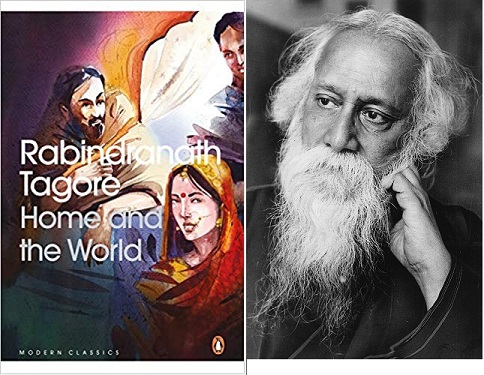


☆ Rabindranath Tagore :- 

Rabindranath Tagore born on 7th May, 1861 in Calcutta ( Now Kolkata) , in India. He was Bengali Poet, short story writer , song composer, Playwright , essayist and Painter who introduced new Prose and verse forms and the use of  Colloquial language into Bengali literature, thereby freeing it from traditional models based on Classical Sanskrit. He was highly influential in introducing Indian culture to the west and  vice versa, and he is generally regarded as the outstanding creative artist of early 20th century India. In the year 1913, he became the first non - European to receive the Nobel prize for Literature. 

 Although Tagore wrote successfully in all literary genres , he was first of all a Poet. Rabindranath Tagore had  early success as a writer in his native Bangal. With his translations of some of his poems he became rapidly known in the west. In fact his fame attained a luminous height, taking him across continent on lecture tours and tours of friendship. 


 Tagore reshaped Bengali literature and music as well as Indian Art with Contextual Modernism in the late 19th and early 20th centuries. Rabindranath Tagore's Poetic songs were viewed as spiritual and mercurial ; however,  his elegant Prose and magical poetry remain largely unknown outside Bengal. He was a fellow of Royal Asiatic Society. Tagore was known by - 'Gurudeb, Kobiguru and Biswokobi.' 

  Rabindranath Tagore received his nickname 'Gurudev' out of his respect by Pupils at his very unique and Special school, which he established in shantiniketan , called 'Visva Bharati University.' Shanti Niketan was developed and founded by Tagore family. This little town was very close to Rabindranath Tagore.

☆ Major Works :- 

  Tagore's Major Plays are :- 
    
  1. Raja  [The king of the Dark Chamber]

1910

  1. Dakghar [ The Post Office] 

1912

  1. Achalayatan [ The Immovable]

1912

  1. Muktadhara [ The Waterfall ] 

1922

  1. Raktakarabi  [ Red Oleanders] 

1926

  1. Chandalika 

1938


 As earlier I also mentioned that Tagore was first of all a Poet.  Among his fifty and odd volumes of Poetry are ; 

  1. Manasi [ The Ideal One] 

1890 

  1. Sonar Tari [ The Golden Boat ]

1894

  1. Gitanjali [ Song Offerings] 

1910

  1. Gitimalya [ Wreath of songs ] 

1914

  1. Balaka [ The Flight of Cranes ] 

1916


  Rabindranath Tagore also wrote many novels, among them are ; 
  
  1. Chokher Bali 

 1903 

  1. Char Adhyay  

1934

  1. Gora 

1910

  1. The Home and the World 

1916

  1. Shesher Kabita 

1929 ( In 1946 it is Published in English language). 


  Rabindranath Tagore is the author of several volumes of short - Stories. He often Published his works first in Bengali languages and then translated his own works into English language. The national anthems of India and Bangladesh  - 'The Jana Gana Mana' and the ' Amar shonar Bangla'    respectively are from Rabindrasangeet. 

  While Rabindranath Tagore Pursued writing, teaching and activism during much of his life, he became recognized as a Painter when he was in his sixties, with many of his works enjoying success at Exhibition in Europe.  

 Tagore died on August 7, 1941 , in Calcutta. 

☆ The Home and the World :-


  The novel " The Home and the World"  Originally written in Bengali language under the title Ghare Baire (ঘরে বাইরে)    in the year 1916 by Rabindranath Tagore.   This novel depicts the battle Tagore had with himself, between the ideas of Western culture and revolution against the Western Culture. These two ideas are Portrayed in two of the main characters - Nikhilesh and Sandip. 

  Nikhilesh who is rational and opposes Violence, On the other side, Sandip who will let nothing stand in his way from reaching his goals. These two opposing ideals are very important in understanding the history of Bengal region and its Contemporary Problems. The novel was translated into English language by the author's nephew, Surendranath Tagore, With input from the author, in 1919. The Home and the World was among the Contenders in a 2014  list by The Telegraph of the 10 all - time greatest Asian novels.  Particularly Important to the novel is an understanding of the Swadeshi movement as a Part of the Indian Nationalist movement. The Swadeshi movement started in response to the 1905 Partition of Bengal by Viceory Lord Curzon, which temporarily Seperated Hindu and Muslims into different Geographical areas.


   ■ Major Characters :- 

    In this novel , there are main three Major characters and the entire story is told through the viewpoints of the three main characters. The novel includes minor characters also like ; 

   ● Bimala's Sister in law :- Who is keen to mock and Criticise Bimala. 

   ● Chandranath Babu - Nikhilesh 's former tutor , a highly respected and kind old girl. 

  ● Amulya :- A Young man whose loyalties are divided between Sandip and Bimala. 

       Now let us discuss the three major Characters of the novel. They are ; 

   1. BIMALA

2. NIKHILESH

3. SANDIP


  Let us discuss and explore the deep study and analysis of all three major Characters. 

  1.Bimala :-   Bimala is the main character and narrator in the novel. She is the wife of Nikhilesh. Bimala in Rabindranath Tagore's novel - " The Home and the world" is Perhaps the liveliest character of the story. She is the centre of action as well as attraction of the novel. 

  There are two sides of Bimala. She is obligated to serve her husband and take of the household. Yet, She is also willing to overstep these boundaries to speak out for the people. In the beginning of the Novel , she herself admits in the course of  the novel that , she had a dark complexion and lacked Physical beauty. Yet she was fortunate enough to get married into the Zamindar's house. Bimala was married to Nikhilesh because of some good astrological signs in her and it was predicted that she would turn out to be an ideal wife. She got educated, introduced to the modern age and well acquainted with the modern standard of living. Bimala remained a devoted wife in spite of Nikhil's desperate endeavors to modernize her. She believed that her true place was at her husband's feet. She was Inspired by her own mother in wifely dedication and tried to fulfil her wifely duties in the same way as her mother has done. She makes it clear that she is destined to be a Perfect wife. She worships her husband and considers him to be his lord. Bimala explicitly tells that every morning , she took the dust of her husband's feet without waking him as ; 

        "At such moments she could feel the vermilion mark upon her forehead and shining out like the morning star." 

 As the novel Progresses, A new phase in Bimala's life has begun. She came out of her home - spun life and her wifely devotion, Partly because of Nikhil's Instigation and partly because of Sandip's charm. Moreover Sandip's impulsive and Persuasive manner , and exalted voice moved her away from her old reliance on her husband's sober , restrained idealistic stand. Nikhilesh allowed Sandip to consult Bimala on every little matter, relating to the great cause of  the Swadeshi. Sandip Actually flattered Bimala , and Conceded to her every suggestion after starting initial difference in an Opinion. In this way we can say that ; 

    " Sandip made a secret entry into Bimala's inner World."


  We can find Bimala's dilemmas throughout the novel. After suffering disillusionment Bimala finally returned to Nikhilesh - the centre of her life and love. In fact, she had never loved Sandip truly , Though she was fascinated by his charm, external glamour and show. But, when Sandip's cupidity get exposed and Bimala came to know the truth, Her retreat to her home and husband Nikhil becomes easy and inevitable. Bimala's inner conflict, agony and tension passed away when she returned to Nikhilesh - who stands for Bimala's true love.


2.Nikhilesh :-    Nikhilesh or Nikhil is Bimala's husband and a wealthy merchant with Progressive views. For much of the novel , somewhere he feels that he is losing Bimala's respect. 

 Nikhil is Bimala's well to do husband and a merchant who owns an estate and two marketplaces in Bengal. He is educated and described as 'Modern' and Progressive in his Outlook. He sees his wife as his equal , and he would go to great pains to see her happy, even if that means her  leaving him. As the novel or story Progresses , he begins to feel as though he is not enough for his wife. As a result he grows more and more melancholy , distancing himself from her and focusing on improving himself as he anticipates her leaving.


Nikhil is a humanist , and he sees dignity in all other people, even in his enemies. Such a view of him allows him to taken advantage of, such  as by his Sister and Sandip. Nikhil's humanist stance also Presents him from siding with one Particular faction ; he sees value in both traditionally  Indian and English ways of thinking. Nikhil rarely asserts himself when People take advantage of him because he often feels that he has no power or right to his own possessions and Thoughts. Nikhil was an Inspired Idealist. 

    "He lived and Worked and stood for what he Considered to be the truth of all life."

  In Nikhil, the hero of 'The Home and the world', a good deal of Tagore's Personal views and Ideology has come out. His Political philosophy, Concept of nationalism radical and advanced views about female education and liberal yet profound sense of love are all Subtly expressed in the character of Nikhilesh (Nikhil).

 3. Sandip :-   Sandip is the third major Character in Rabindranath Tagore's novel -'The Home and the world', Completing the love triangle. He is a guest in the home of nikhil and Bimala and his revolutionary ideas and speeches have a significant impact on the character of Bimala. He is very vocal in his anti - imperialistic views and is a skilled orator. 

   "Sandip represents Characteristics that are directly opposite to Nikhil."

  Sandip is impassioned and Stirs the emotions not only on Bimala , but the People of Bengal. He spreads  the notion of Swadeshi - using goods made locally and Boycotting British ones.  He was a kind of Person who trying to use Bimala and also her money. However his character is far from ideal Patriot. His motivations are selfish. He fools People with his mask of goodness , something that nikhil sees through the beginning of  Sandip's relationship with his mother.


     At one Point in the novel he Convinced Bimala to steal money from her house and her husband for the 'Cause.' Sandip's Presence in the novel Concludes him fleeing. While , His Speeches and ideas are resulted in Communal riots.

Critical analysis of the novel : 


The novel explores the theme of nationalism through its characters and their differing beliefs. Sandip represents blind nationalism, with his passionate speeches about Swadeshi (the use of indigenous goods) and the slogan "Vande Mataram." He can persuade others easily with his words, but his views are extreme and not always practical. 

Bimala, on the other hand, starts out as a traditional wife who believes that she should worship her husband, Nikhil. However, as she gets more educated and exposed to the outside world, she begins to question her role and the ideas around her. Nikhil, a wealthy and respected landowner, supports her desire for education and freedom, encouraging her to think for herself. He understands the importance of the Swadeshi movement but doesn't follow it blindly. Nikhil is more concerned about the poor, who might struggle with the high cost of using only Indian-made goods.

The central conflict of the novel revolves around the tension between Nikhil and Sandip, both of whom want to influence Bimala's thinking. Nikhil respects her as an individual and believes she should make her own choices, while Sandip tries to control her by appealing to her emotions and patriotism. Bimala, confused and manipulated by both men, eventually realizes her mistakes and gains clarity about her own thoughts and feelings.

The novel also reflects the views of Rabindranath Tagore, the author, who was initially supportive of nationalism but later became critical of its blind and extreme forms. Nikhil’s character embodies Tagore’s criticism of nationalism as an ideology that can sometimes be misused for personal gain, as seen in Sandip’s manipulation of the youth, like Amulya, who is drawn into the movement without understanding its full implications.

Through the character of Bimala, Tagore emphasizes the importance of women’s education. Bimala’s journey highlights how real education is not just about learning facts or following ideologies, but about developing the ability to think critically. Without this, individuals can easily become like Bimala, swayed by the strong personalities around them, without forming their own opinions.

Nikhil, in contrast, represents the kind of environment where women can be educated and given the freedom to think. He offers a progressive view of marriage, where mutual respect and understanding are key. In a feminist reading of the novel, Bimala’s character can be seen as a symbol of a woman who lacks agency, caught between two men who impose their views on her without allowing her to fully explore her own identity.

In conclusion,

 The  novel critiques both the blind following of nationalism and the limitations placed on women in society, offering a message about the importance of education, self-reflection, and personal freedom. The story remains relevant today, as it highlights how people can be manipulated in the name of patriotism and how crucial it is to think critically before following any ideology.

Examples :

TV Show: Yeh Hai Mohabbatein (2013–2019)

  • Patriarchy and Women's Independence: The character of Ishita Bhalla represents a woman who challenges traditional gender roles while also navigating her relationships. She begins as a respected dentist and a progressive woman, but the show highlights how societal expectations and familial pressures often push women into restrictive roles.
  • Example: Ishita faces constant interference from her in-laws and relatives, which challenges her professional and personal freedom. However, just as Bimala learns to assert her independence in Ghare-Baire, Ishita also gradually fights to balance her independence and her familial responsibilities, advocating for a more progressive vision of marriage and women’s roles in society.

TV Show: Kyunki Saas Bhi Kabhi Bahu Thi (2000–2008)

  • Generational Influence: In this iconic soap opera, Tulsi becomes the central figure around whom many characters revolve. Tulsi, as the “bahu” (daughter-in-law) of a traditional family, has to balance the expectations placed on her with her growing realization of her own values and the need for independence. She is at times manipulated by her family and even by the men in her life, much like Bimala in Ghare-Baire.
Example: At one point, Tulsi must decide whether to follow the patriarchal expectations of her family or to assert her own beliefs. This mirrors Bimala’s dilemma in the novel, where she must choose between the competing demands of Sandip and Nikhil while struggling to find her own voice.

Thank you for visiting my blog!!!


Poems : Lakshman And Deeno Daan by Toru Datt and Rabindranath Tagore 


This blog is a part of thinking activity assigned by Megha Trivedi Mam in I will discuss about the poem Lakshman and Deeno Daan.

Toru Dutt was (4 March 1856 )a poet, novelist, essayist, translator and polyglot. She was an outstanding pioneer in the history of Indian literature. 


In the sphere of Indo-English poetry the era of Renaissance may be termed as the ‘Age of Dutts’ because the age was dominated by the two sisters Toru and Aru and renowned poetical man Romesh Chandra Dutt.
Toru Dutt's work connects Indo-Anglian literature to that of France, highlighting the importance of considering cultural contexts when exploring 19th-century women's poetry.

“When the history of the literature of our country comes to be written, there is sure to be a page in it dedicated to this fragile exotic blossom of song” (Dutt xxvii).
 This sentence is Edmund Gosse's famous final flourish to his memoir of Toru Dutt, which introduced her posthumous volume Ancient Ballads and Legends of Hindustan, published in 1882.
Died: August 30, 1877, Kolkata, india


Q-1: Write a critical note on ‘Lakshman’ by Toru Dutt.


Ans. Lakshman is a poem based on the epic poem Ramayana, in which the episode of abduction of Seeta and golden deer episode is retold by Toru Dutt. The characters are well portrayed in which the dialogue between Seeta and Lakshman is the main focus of the poem. Ram goes to bring the golden deer, when it was being killed by Ram it makes the sound like Rama that Sita and Lakshaman hear and Sita thinks that Ram is in danger. Lakshaman knows the strength of Ram so he knows he can not be defeated but Sita got nervous that he might be dying. 


The depiction of the character is quite different in this episode and in Toru Dutt’s poem it is quite a different portrayal of the characters. Laksham is known for his anger and Sita is known for her docility but in the poem Sita becomes more ferocious and speaks language that is unbearable for Lakshman. On the other hand, Lakshman patiently listens to all the harsh words of Sita and does not say anything in anger; he just bears everything. Toru Dutt has wonderfully portrayed the character. Lakshman’s character is there in the epic Ramayana but he is not considered as a hero or the central figure but in the poem the patient and the respect that he has for Sita is admirable. In the poem Lakshman is a hero who is in a way in a dilemma about what to do. On one side there is a Sita who is continuously telling him to go and save Ram. On the other side Ram has told to do  protection of Sita until he returns. 


The poem shows Sita is not a godly figure or even a person with the faith, she rather becomes the emotional fool and falls in the trap of Raavan. If Sita is that knowledgeable and faithful in his husband she would know that Ram is undefeated. The harsh words that she uses for Lakshman that he wants to marry her after the death of ram shows the mentality of Sita's character. A brother who has given up everything and goes to the forest to live only to help Ram, she doubts that person. And in Lakshman's case we find how calmly he handles the situation. In this stanza as we see,


"And now farewell! What thou hast said,

Though it has broken quite my heart,

So that I wish I were dead —

I would before, O Queen, we part,

Freely forgive, for well I know

That grief and fear have made thee wild,

We part as friends, — is it not so?"

And speaking thus he sadly smiled.”


He leaves her with a smile on his face and says that we are departing as a friend not as a rival. He then and there forgives her and accepts that now the situation is not in his hand. He understands her situation and what she is going through he says “That grief and fear have made thee wild”. The real person who understands the situation and still he is not able to do anything. That is the tragedy of Lakshaman. 


Q-2: Why does the poet say that God does not live in the Temple? Give reasons.

Ans. 

The poem ‘Deeno Dan’ is a poem written by Rabindranath Tagore. Tagore is a well known Indian poet. In this particular poem he talks about the wealth that is spent unnecessarily in building the temple. In the poem there is a conversation between a king and a hermit, who goes against the idea that the king has wasted the money in temples instead of helping the poor farmers who are suffering due to a drought. 


“At this,

The fretful king dismounted from his throne to go

Where the hermit sat beneath the tree. Bowing, he said,

“My lord, why have you forsaken god’s mighty abode,

The royal construction of gold that pierces the sky,

To sing paeans to the divine here on the streets?’

“There is no god in that temple,” said the hermit.”


Here in the second stanza the reference come when the king asks to hermit why are you not going to the temple for  worshipping and staying under the tree. The hermit replies that there is no god in that temple. He says that the temple is full of your royal arrogance, the god has left that place long ago. The hermit also argues that when people come to you for help because they were dying of hunger and you refused to help them and now you have spent a lot of money in the temple that is why there is no  god  in the temple.


There are very good ideas that Tagore tries to give in  that the god does not live in the temple but he lives where the people worship him. The god does't need the temple for himself; he lives everywhere you can worship him anywhere no need to build a huge temple for him. People rather helps  money to help other people that can be helpful for people in many ways. King represents the large number of people who think that the temples are necessary for god Tagore tries to break that myth and says that you can worship god under a tree also. 


Tagore himself comes with a very revolutionary idea that the majority of the people might not like that but still he says the truth. In the contemporary time also there are people who might be following the ideology of building the temple built resent Ram Mandir in Ayodhya one so in that context Tagore gives the insight of true worshipping. 


Thank you for visiting 🤠 my blog!!!


Mahesh Dattani's Final Solution

 Mahesh Dattani's Final Solution 

This blog is based on the activity where we have read and performed the play of Mahesh Dattani's on the stage and have also rehearsal it many a times and it is assigned by Alpa Ponda Mam, Department of English, MKBU.


The which was performed by all the students of batch 2024 Sem 3.


How does Mahesh Dattani manipulate time and space within the dramatic framework of Final Solutions to create meaning?


 Explore the interplay of these elements with specific reference to the stagecraft techniques employed by the playwright. Ans: In the play we find the past and the present of Hardika. When she came to her in-laws home newly married and the experience of her still reflected on the stage through the memory of Hardika. Dattani wonderfully captures the past and the present in his play. In the beginning of the play we might wonder why the Ramnik was so eager to give a job to the Javed but lately we know that the shop belongs to another persona and they burnt the shop and took that from Muslim family. The regret that Ramnik suffers makes him do something good for Javed. In Javed’s case there is a past that he also suffers from. He was a person who was one of the troublemakers in the riots but now he has changed. But others do not let him forget that accident, his humanity does not allow him to kill the Poojari. His background incident in childhood also made him follow such a path but he was misguided. This story told by Bobby adds sympathy for Javed in the audience's heart. There is a wonderful role that is given to the chorus, that becomes the public sometimes they become the members of Hindu and Muslim crowd. This shows the hatred of the people among various religious groups. 


Examine the complexity of guilt experienced by the characters in the play. How does this emotion shape their actions and relationships?

Firstly the character who is more in guilt is Ramnik, because he knows what his father has done to the shop of a Muslim family. So time and again tries to give a job to Javed to get out from the guilt. In the story we also find that due to his guilt he gives shelter to Javed and Bobby.

In Javed’s character there is also a guilt that he was associated with the group that spreads riots. In that he knows whatever he did was wrong but he justified it with what happened to him in childhood.

At last when Hardika gets to know about the wrong deed of her family, she also feels guilty and she asks Ramnik why did he not tell her that before. And he replies that now she only has to live with that for a few years.

Smita also regrets that she misbehaved with Javed in anger, later she gets to know about the past and she feels sorry for him.

Reflect on your journey through Final Solutions as a student of theatre. How did the process of studying, rehearsing, and performing this play shape your understanding and appreciation of theatre?


In the workshop we read the whole play with intonation. There we get to know about the characters and their way. We also tried to read between the lines, and get the essence of the play. In the performance there is altogether a different story, there we have to remember the dialogue.

On the first day when I got to know about my role I gave up on the first day, that I thought I could not remember all the dialogue. But later on I was able to remember the dialogue and then only I was able to put my emotions into that.

While practising the scene with others I also learned to be patient, sometimes I forgot the dialogue sometimes others also forgot the dialogue, at that time we supported each other and gave prompts to one another. I learned to cooperate with others and work as a team.

On the performance day I was a little nervous, in the final rehearsal I performed not quite not well, that makes me more nervous. But in the final performance I performed quite well, so many people praised me. I was happy and satisfied with my performance.

Thank for visiting my blog!!!


Friday, 15 November 2024

Pravin Gadhvi's Laughing Buddha

 Laughing Buddha

This   blog is based on the Pravin Gadhvi's Poem Laughing Buddha assigned by Prakruti Bhatt Mam, Department of English, MKBU.


Pravin Gadhavi, born on May 13, 1951, serves as an IAS Officer in the Gujarat Government. He is also a renowned writer, with poetry collections titled 'Bayonet' (1985), 'Padchhayo' (1996), and 'Tunir' (2002). His short story compilations include 'Pratiksha' (1995), 'Antarvyatha' (1995), and 'Surajpankhi,' with the latter receiving an award from the Government of Gujarat.


Presented here is the entire poem, "Laughing Buddha", written by Pravin Gadhvi.


(Full Moon day of Buddha's birthday)

There was an

Underground atomic blast on

Buddha's birthday-a day of

Full Moon


Buddha laughed!


What a proper time!

What an auspicious day!


Buddha laughed!


At whom ?


There was a laughter on his

Lips and tears in his

Eyes

He was dumb that day.


See,

Buddha laughed!


Reference of the poem:


On May 18th, 1974, India became one of the few countries in the world to test a nuclear bomb. This big event happened in the desert of Rajasthan, at a place called the Pokhran Test Range. It was given the name "Smiling Buddha". Interestingly, this day was also Buddha Purnima, a very special day for Buddhists because it is the birthday of Siddhartha Gautama, who became the Buddha.

to get more information on operation smiling buddha (Click here)


Here is the answers to the questions related to Pravin Gadhvi's poem  Laughing Buddha 


 Q-1) What should be of a higher moral importance for governing bodies, national security, or basic needs of its citizens? What do you think is Gadhvi's opinion about this?

Response:

National security is important to keep a country safe from external threats. However, people's basic needs—like food, water, healthcare, and education—are crucial for a decent life. 


Gadhvi’s poem focuses on inner peace and harmony, which suggests that he may believe that taking care of citizens' basic needs should come first. If people’s basic needs are met, they can live peacefully, which would naturally make a nation secure.


Overview :While safety is crucial, it's equally important for governments to ensure that people’s basic needs are fulfilled for a truly peaceful society.


Q-2) In light of Henri Bergson's essay titled Laughter : An Essay On The Meaning Of The Comic,  share your thoughts about the possible interpretations of Buddha's laughter in Gadhvi's poem.

Response:

Henri Bergson believed that laughter arises from unexpected situations that don’t fit into our normal life experiences—like seeing someone trip in a funny way. 


In Gadhvi's poem, the Buddha's laughter is unexpected because he’s usually known for wisdom and calmness. His laughter here might reflect how absurd life can be. It could symbolize how life is full of contradictions but still offers moments of joy.


Or, maybe the laughter represents something deeper. It might be Buddha’s way of showing that life, with all its ups and downs, should be taken lightly, encouraging us to find peace even in difficult times.


Overview : Buddha’s laughter might invite us to see life’s contradictions with a lighter, more accepting view.


Q-3)  The rise and fall of significance of a particular moment in history depends on the narrative that is built around it. Discuss this statement with specific reference to Laughing Buddha. 

Response:

The poem talks about India's first nuclear test, called  Smiling Buddha on the Buddha’s birthday. This event was significant for India but happened during a time when many Indians were struggling with poverty. Critics saw it as a misuse of resources.


Initially, people criticized India for focusing on nuclear power instead of helping its citizens. But over time, as India's economic condition improved, later nuclear tests were seen as a sign of strength and progress.


Overview : This shows how the way we narrate history affects its significance. The same event can be viewed differently depending on the context and the stories people tell about it.


 Q-4) Share your interpretation of the lines: "What a proper time! What an auspicious day!"


Response: 

The lines “What a proper time! What an auspicious day!” are deeply ironic. Normally, these words are used to celebrate something good, but here they describe a nuclear explosion on Buddha’s birthday—a day that represents peace and compassion.


By using words like 'proper' and 'auspicious' in this context, the poet makes us question how society can celebrate something so destructive. It’s a powerful way to criticize the gap between our ideals (peace) and our actions (violence).


Overview : These lines highlight the absurdity of celebrating a violent act on a day that’s supposed to symbolize peace, pushing us to rethink what we value as a society.


Thank you for visiting my blog!!!🙂🙂🙂


'Black' movie review

 'Black' Movie Review 

This blog is a part of 'Black' Movie screening in which I will share some point of critical views in this blog.


Here is the trailor of movie 👉.


About Black movie : 

Sanjay Leela Bhansali co-wrote, directed, and co-produced "Black," a 2005 Indian drama film in English and Hindi. The film stars Rani Mukerji and Amitabh Bachchan, with Shernaz Patel and Dhritiman Chatterjee in supporting roles. It centers on Michelle (Mukerji), a woman who is deaf-blind, and her relationship with her teacher Debraj (Bachchan), an elderly alcoholic instructor who later develops Alzheimer's disease. It all started when he met a group of physically challenged youngsters while filming Khamoshi: The Musical in the 1990s.


Helen Keller's life and her autobiography, "The Story of My Life," published in 1903, inspired the story. The film received widespread acclaim from critics, who lauded the narrative, Bhansali's direction, and the performances, particularly those of Bachchan and Mukerji. It won a total of eleven Filmfare Awards, the most for a single film at that time, along with three National Film Awards. Bachchan received awards for Best Feature Film in Hindi and Best Actor. In 2013, "Benim Dünyam," a Turkish adaptation, was released.


    "Sanjay Leela Bhansali’s Black is not just a film; it's an experience. It’s a journey into the depths of human spirit, a testament to the indomitable power of the mind, and a stark portrayal of the complexities of the teacher-student relationship."


Disability Perspective: 


The film explores the profound challenges faced by Michelle, portrayed by Rani Mukerji, as she navigates a world of darkness and silence. Her disability is portrayed with depth, focusing on her internal experiences and her relentless quest to communicate and connect.

Debraj’s Philosophy


Dialogue: 


                “Life is an ice cream. Enjoy it before it melts.”


in this dialogue, Debraj shares this metaphor with Michelle, encouraging her to embrace life and its fleeting moments. This line reflects Debraj’s philosophy of living life to the fullest, despite its challenges and impermanence.


Michelle’s First Word: 


While watching this scene from the movie, we realized that after much struggle and persistence, Michelle finally uttered her first word, "water," as she felt the water flow over her hands.


This moment is a breakthrough in Michelle’s education and communication. It symbolizes the beginning of her journey towards understanding and interacting with the world.


From a cinematographic perspective, this frame utilizes close-up shots of Michelle's hands and face to capture the intense emotions and the pivotal nature of the moment. The lighting is deliberately bright, symbolizing enlightenment and hope.


The Teacher and the Student: A Complex Dynamic


The movie is mainly about the complicated relationship between Debraj and Michelle. They fight a lot but also deeply care for each other. Amitabh Bachchan plays Debraj, a very smart but troubled man who wants to make a big difference. Rani Mukerji plays Michelle, and she shows how much she's feeling without saying much. Her face tells a powerful story.


The Role of the Teacher & The Power of Human Connection: 


Debraj Sahai is not just a teacher; he is a catalyst for change. His character challenges the traditional role of a teacher, moving beyond the mere imparting of knowledge. He becomes a surrogate parent, a therapist, and a relentless advocate for his student. The film emphasizes the importance of teachers as mentors and role models.

At its core, Black is a story about human connection. The bond between Debraj and Michelle is a testament to the power of empathy and understanding. The film suggests that it is through these connections that we find meaning and purpose in life.


Black also touches upon the theme of intergenerational relationships. The film explores the complexities of the bond between teacher and student, as well as the challenges faced by older generations in adapting to a changing world.

A Window into Child Psychology: 


Black is a powerful exploration of child psychology. It delves into the world of a child who is denied the basic human senses. Michelle's behavior, her rage, her frustrations, are all manifestations of a mind trapped in a silent, dark prison. The film underscores the importance of early intervention and specialized education for children with disabilities.


Inspirational Value:

Black is undeniably uplifting, showcasing the triumph of the human spirit against seemingly insurmountable challenges. Michelle’s journey from a world shrouded in darkness and silence to one filled with communication and connection exemplifies the transformative power of education and sheer determination. The film inspires viewers to look beyond disabilities, urging them to recognize the untapped potential within every individual. It also highlights the significant role of dedicated educators in changing lives, making it a compelling watch for those who believe in the transformative power of teaching and learning.


A Film Worth Watching?

Absolutely, Black is a film that lingers in your mind long after the credits fade. It challenges your perceptions, provokes deep thought, and ultimately fills you with a sense of hope. At its core, it’s a story of resilience, human connection, and the unyielding power of love. It’s not merely a film but a call to action, reminding us that even in the darkest moments, there is always a glimmer of hope. It embodies the belief that every person, no matter their circumstances, holds the potential to achieve greatness.


Conclusion:

In summary, Black  stands as a cinematic masterpiece that delves deeply into themes of disability, education, and the human spirit. Its compelling performances, innovative teaching approaches, and nuanced exploration of child psychology make it a film worth experiencing. The inspirational essence of the film is rooted in its celebration of resilience and the profound impact of education. With Bhansali’s masterful direction and breathtaking cinematography, Black  becomes a must-watch for anyone in search of a deeply emotional and thought-provoking cinematic journey. 

Thank you for visiting!!! 🙂 🙂 


Wednesday, 13 November 2024

Short Stories by R.K. Narayan

Short Stories by R.K. Narayan

This blog is a part of thinking activity task assigned by Megha Trivedi Mam, Department of English, MKBU.

An Astrologer's Day is a Short Story 


AN ASTROLOGER'S DAY

Punctually at midday he opened his bag and spread out his professional equipment, which consisted of a dozen cowrie shells, a square piece of cloth with obscure mystic charts on it, a notebook, and a bundle of palmyra writing. His forehead was resplendent with sacred ash and vermilion, and his eyes sparkled with a sharp, abnormal gleam which was really an outcome of a continual searching look for customers, but which his simple clients took to be a prophetic light and felt comforted.
The power of his eyes was considerably enhanced by their position—placed as they were between the painted forehead and the dark whiskers which streamed down his cheeks: even a half-wit’s eyes would sparkle in such a setting. To crown the effect he wound a saffron-colored turban around his head. This color scheme never failed.
People were attracted to him as bees are attracted to cosmos or dahlia stalks. He sat under the boughs of a spreading tamarind tree which flanked a path running through the town hall park. It was a remarkable place in many ways: a surging crowd was always moving up and down this narrow road morning till night. A variety of trades and occupations was represented all along its way: medicine sellers, sellers of stolen hardware and junk, magicians, and, above all, an auctioneer of cheap cloth, who created enough din all day to attract the whole town. Next to him in vociferousness came a vendor of fried groundnut, who gave his ware a fancy name each day, calling it “Bombay Ice Cream” one day, and on the next “Delhi Almond,” and on the third “Raja’s Delicacy,” and so on and so forth, and people flocked to him. A considerable portion of this crowd dallied before the astrologer too. The astrologer transacted his business by the light of a flare which crackled and smoked up above the groundnut heap nearby.
Half the enchantment of the place was due to the fact that it did not have the benefit of municipal lighting. The place was lit up by shop lights. One or two had hissing gaslights, some had naked flares stuck on poles, some were lit up by old cycle lamps, and one or two, like the astrologer’s, managed without lights of their own. It was a bewildering crisscross of light rays and moving shadows. This suited the astrologer very well, for the simple reason that he had not in the least intended to be an astrologer when he began life; and he knew no more of what was going to happen to others than he knew what was going to happen to himself next minute. He was as much a stranger to the stars as were his innocent customers. Yet he said things which pleased and astonished everyone: that was more a matter of study, practice, and shrewd guesswork. All the same, it was as much an honest man’s labor as any other, and he deserved the wages he carried home at the end of a day.
He had left his village without any previous thought or plan. If he had continued there he would have carried on the work of his forefathers—namely, tilling the land, living, marrying, and ripening in his cornfield and ancestral home. But that was not to be. He had to leave home without telling anyone, and he could not rest till he left it behind a couple of hundred miles. To a villager it is a great deal, as if an ocean flowed between.
He had a working analysis of mankind’s troubles: marriage, money, and the tangles of human ties. Long practice had sharpened his perception. Within five minutes he understood what was wrong. He charged three paise8 per question, never opened his mouth till the other had spoken for at least ten minutes, which provided him enough stuff for a dozen answers and advices. When he told the person before him, gazing at his palm, “In many ways you are not getting the results for your efforts,” nine out of ten were disposed to agree with him. Or he questioned: “Is there any woman in your family, maybe even a distant relative, who is not well disposed towards you?” Or he gave an analysis of character: “Most of your troubles are due to your nature. How can you be otherwise with Saturn where he is? You have an impetuous nature and a rough exterior.” This endeared him to their hearts immediately, for even the mildest of us loves to think that he has a forbidding exterior.
The nuts vendor blew out his flare and rose to go home. This was a signal for the astrologer to bundle up too, since it left him in darkness except for a little shaft of green light which strayed in from somewhere and touched the ground before him. He picked up his cowrie shells and paraphernalia and was putting them back into his bag when the green shaft of light was blotted out; he looked up and saw a man standing before him. He sensed a possible client and said, “You look so careworn. It will do you good to sit down for a while and chat with me.” The other grumbled some reply vaguely. The astrologer pressed his invitation; whereupon the other thrust his palm under his nose, saying, “You call yourself an astrologer?” The astrologer felt challenged and said, tilting the other’s palm towards the green shaft of light, “Yours is a nature ...” “Oh, stop that,” the other said. “Tell me something worthwhile....”
Our friend felt piqued. “I charge only three paise per question, and what you get ought to be good enough for your money....” At this the other withdrew his arm, took out an anna, and flung it out to him, saying, “I have some questions to ask. If I prove you are bluffing, you must return that anna to me with interest.”
“If you find my answers satisfactory, will you give me five rupees?”
“No.”
“Or will you give me eight annas?”
“All right, provided you give me twice as much if you are wrong,” said the stranger. This pact was accepted after a little further argument. The astrologer sent up a prayer to heaven as the other lit a cheroot. The astrologer caught a glimpse of his face by the match light. There was a pause as cars hooted on the road, jutka drivers swore at their horses, and the babble of the crowd agitated the semidarkness of the park. The other sat down, sucking his cheroot, puffing out, sat there ruthlessly. The astrologer felt very uncomfortable. “Here, take your anna back. I am not used to such challenges. It is late for me today....”
He made preparations to bundle up. The other held his wrist and said, “You can’t get out of it now. You dragged me in while I was passing.” The astrologer shivered in his grip; and his voice shook and became faint. “Leave me today. I will speak to you tomorrow.” The other thrust his palm in his face and said, “Challenge is challenge. Go on.” The astrologer proceeded with his throat drying up, “There is a woman ...”
“Stop,” said the other “I don’t want all that. Shall I succeed in my present search or not? Answer this and go. Otherwise I will not let you go till you disgorge all your coins.” The astrologer muttered a few incantations and replied, “All right. I will speak. But will you give me a rupee if what I say is convincing? Otherwise I will not open my mouth, and you may do what you like.” After a good deal of haggling the other agreed. The astrologer said, “You were left for dead. Am I right?”
“Ah, tell me more.”
“A knife has passed through you once?” said the astrologer.
“Good fellow!” He bared his chest to show the scar. “What else?”
“And then you were pushed into a well nearby in the field. You were left for dead.”
“I should have been dead if some passerby had not chanced to peep into the well,” exclaimed the other, overwhelmed by enthusiasm. “When shall I get at him?” he asked, clenching his fist.
“In the next world,” answered the astrologer. “He died four months ago in a far-off town. You will never see any more of him.” The other groaned on hearing it. The astrologer proceeded:
“Guru Nayak—”
“You know my name!” the other said, taken aback.
“As I know all other things. Guru Nayak, listen carefully to what I have to say. Your village is two days’ journey due north of this town. Take the next train and be gone. I see once again great danger to your life if you go from home.” He took out a pinch of sacred ash and held it to him. “Rub it on your forehead and go home. Never travel southward again, and you will live to be a hundred.”
“Why should I leave home again?” the other said reflectively. “I was only going away now and then to look for him and to choke out his life if I met him.” He shook his head regretfully. “He has escaped my hands. I hope at least he died as he deserved.” “Yes,” said the astrologer. “He was crushed under a lorry.” The other looked gratified to hear it.
The place was deserted by the time the astrologer picked up his articles and put them into his bag. The green shaft was also gone, leaving the place in darkness and silence. The stranger had gone off into the night, after giving the astrologer a handful of coins.
It was nearly midnight when the astrologer reached home. His wife was waiting for him at the door and demanded an explanation. He flung the coins at her and said, “Count them. One man gave all that.”
“Twelve and a half annas,” she said, counting. She was overjoyed. “I can buy some jaggery and coconut tomorrow. The child has been asking for sweets for so many days now. I will prepare some nice stuff for her.” “The swine has cheated me! He promised me a rupee,” said the astrologer. She looked up at him. “You look worried. What is wrong?”
“Nothing.”
After dinner, sitting on the pyol, he told her, “Do you know a great load is gone from me today? I thought I had the blood of a man on my hands all these years. That was the reason why I ran away from home, settled here, and married you. He is alive.”
She gasped. “You tried to kill!”
“Yes, in our village, when I was a silly youngster. We drank, gambled, and quarreled badly one day—why think of it now? Time to sleep,” he said, yawning, and stretched himself on the pyol.


2)Crime and Punishment 


R.K. Narayan 


Rasipuram Krishnaswami Narayan famously known as R.K. Narayan, was an Indian writer and novelist known for his work set in the fictional South Indian town of Malgudi.

Born : 10, October 1906, Chennai
Died : 13, May 2001, Chennai
Awards : Filmfare Award for Best Story, Padma Vibhushan, Padma Bhushan
Education : Maharaja's College, University of Mysore. 

Crime and Punishment : 

Crime and Punishment is a short story 

The teacher child relationship is humorously presented in the story. The child gives repeated wrong answers on purpose. But the teacher is not in a position to enjoy his playful behaviour. In a sudden response he slaps on the child's cheek. He threatens him to report the matter to his parents. The teacher asks him to be bold like a soldier and take it silly. He replies, "A soldier will shoot with a gun if he is hit." What follows is the teacher being blackmailed for his crime. He is made to play the station master and tell stories. Already exhausted with work he refuses to obey him. The child runs out to the parents and the teacher follows. He runs after him around the garden three times and collapses on the portico step. The twist in the story happens when the parents come out and enquire about his maths test. The word 'test' frightens the child and he hides behind his parents, begging the teacher to not betray him. The teacher is relieved and says he is catching up. The teacher saves the student and in turn saves himself from his crime.


Here are the suitable examples of movies, novels or short stories related to R.K. Narayana crime and Punishment 
(generated with the help of Chatgpt)


1. Movies

To Sir, with Love (1967):

 This film, starring Sidney Poitier, deals with the dynamics between a teacher and rebellious students. The story explores respect, discipline, and personal transformation, though with a more positive outcome compared to Narayan’s story.

Dead Poets Society (1989):

 While not directly about crime or punishment, this film focuses on the influence a teacher has over his students, which leads to unintended consequences, touching on themes of authority and guilt.
Whiplash (2014): A powerful film about the intense relationship between a demanding music teacher and his student. The psychological tension and abuse of authority echo the teacher-student dynamic in Narayan’s story, exploring the lengths one might go to achieve success.

2. Novels

Lord of the Flies by William Golding: 

This novel explores the dark side of human nature when left unchecked by societal rules. It reflects on authority, punishment, and the moral dilemmas of leadership, somewhat parallel to the moral questioning in Narayan's story.

The Remains of the Day by Kazuo Ishiguro:

 Although centered on a butler’s reflections on his life, the novel deals with obedience to authority and the resulting guilt. It explores the moral implications of actions taken under the guise of duty.

Hard Times by Charles Dickens: 

This novel critiques the rigid education system in Victorian England and the power wielded by educators, similar to the teacher's authority over the student in Crime and Punishment.

3. Short Stories

The Use of Force by William Carlos Williams:

 This short story revolves around a doctor's forceful attempt to examine a sick child. It delves into the dynamics of power, authority, and moral ambiguity, akin to Narayan’s exploration of the teacher-student relationship.

The Lottery by Shirley Jackson:

 Although this story deals with a different setting, it explores the theme of authority and societal norms, showing how individuals justify cruel acts under the guise of tradition.

The Lesson by Toni Cade Bambara: 

This story highlights the power dynamics between a teacher and students, focusing on themes of education, authority, and social inequalities.

These examples explore themes similar to those in Narayan’s Crime and Punishment, such as authority, power imbalance, guilt, and the consequences of one's actions.

Thank you for visiting my blog and it will be useful to you !!!

Monday, 11 November 2024

Marginalization in Shakespeare’s Hamlet and Stoppard’s Rosencrantz and Guildenstern Are Dead

 Thinking Activity: 

Exploring Marginalization in Shakespeare’s Hamlet and Stoppard’s Rosencrantz and Guildenstern Are Dead

This blog is a part of thinking activity assigned by Professor Dr.Dilip Barad Sir which is based on Cultural studies.


1. Marginalization in Hamlet 

o Describe how Rosencrantz and Guildenstern represent marginal figures in Hamlet. How does Hamlet’s reference to Rosencrantz as a “sponge” reflect their expendability in the power dynamics of the play?

Response : 

In Hamlet, Rosencrantz and Guildenstern are depicted as minor characters with little power or agency. They are used by King Claudius to spy on Hamlet, showing their lack of independence and purpose. Hamlet calling Rosencrantz a "sponge" highlights how easily they are used and discarded by those in power. Just like a sponge absorbs and is later squeezed dry, these characters serve Claudius’ needs until they are no longer useful, at which point they are cast aside, eventually leading to their deaths.


2. Modern Parallels to Corporate Power 

o The passage compares Rosencrantz and Guildenstern to modern workers impacted by corporate downsizing and globalization. Reflect on this parallel: How does their fate in Hamlet mirror the displacement experienced by workers when multinational companies relocate or downsize? 

Response: 

The fate of Rosencrantz and Guildenstern in the play can be likened to modern-day workers affected by corporate downsizing or globalization. Just as these characters are manipulated by the king and then discarded, employees today can feel like expendable resources when companies relocate or cut jobs to save money. These workers, much like Rosencrantz and Guildenstern, often have little control over their fate, being moved around like chess pieces by those in Power.


3. Existential Questions in Stoppard’s Re-interpretation  

o In Rosencrantz and Guildenstern Are Dead, Stoppard deepens their marginalization by questioning their existence and purpose. Why might Stoppard emphasize their search for meaning in a world indifferent to them? How does this mirror the feeling of powerlessness in today’s corporate environments?

Response :

In Tom Stoppard’s Rosencrantz and Guildenstern Are Dead, the characters are even more marginalized as they question the meaning of their existence. Stoppard focuses on their confusion and lack of control over their lives, highlighting the existential crisis of trying to find meaning in a world that seems indifferent. This mirrors the sense of powerlessness that many people today experience in large corporations where they feel like insignificant parts of a much larger, impersonal machine. 


4. Cultural and Economic Power Structures 

o Compare Shakespeare’s treatment of power in Hamlet to Stoppard’s reimagining. How does each work critique systems that marginalize “little people”? How might Stoppard’s existential take resonate with contemporary issues of job insecurity and corporate control?

Response :

Both Shakespeare and Stoppard critique how those in power marginalize the "little people." In Hamlet, the focus is on how kings and princes use others for their own ends, while Stoppard shifts the focus to existential and philosophical questions, relevant to modern issues like job insecurity. Stoppard’s portrayal resonates with today’s world, where workers can feel powerless in the face of corporate decisions that prioritize profits over people.


5. Personal Reflection 

o How does the marginalization of Rosencrantz and Guildenstern in Hamlet relate to the modern experience of being seen as a dispensable “asset”? Reflect on how these parallels shape your understanding of Cultural Studies and power dynamics.

Response :

The way Rosencrantz and Guildenstern are treated in Hamlet as expendable reflects how some employees are seen in modern companies—as disposable "assets" rather than people with value. This realization deepens our understanding of Cultural Studies by showing how power structures can marginalize individuals, whether in literature or in real life. It reveals the harsh reality of power dynamics, where the less powerful are often at the mercy of those who control resources and decisions.


Assignment 210A : Research Project Writing : Dissertation Writing

 Assignment 210A : Research Project Writing : Dissertation Writing This blog is a part of Assignment writing in which I will discuss about m...